Find 3 examples of daily homeschooling schedules (light, normal, intensive) complete with ideal total study hours. Children’s learning routine guide + homeschooling solutions from Edumaster.
3 Examples of Daily Homeschooling Schedules that are Effective for Children and Easy to Follow
Having an effective homeschooling schedule is very important so that children learn regularly and parents can easily follow it.
Many parents currently feel overwhelmed when they have to accompany their children to study at home every day. The transition from formal school to home-based education certainly requires quite a bit of adjustment.
Without a directed homeschooling schedule, a child’s learning process can become chaotic and inconsistent. This often triggers stress, both in confused children and exhausted parents.
In fact, education at home should be a fun moment and bring family relationships closer. The key lies in how Moms design a routine that balances academics and play time.
This article will guide Mom and Dad in understanding how to create the right schedule for their beloved child. We will also share three examples of daily schedules that Moms can immediately adapt at home.
The goal is for children to remain productive, happy, and their maximum potential can develop well. Let’s discuss step by step how to build an ideal learning environment.

What is the Ideal Total Study Hours in a Child’s Study Routine?
Many parents are trapped in the idea that children have to study from morning to evening like in formal schools. In reality, the duration of studying at home is much shorter but the level of effectiveness is much higher.
This is because there are no waiting times, queues, or mass interruptions like in conventional classes.
The following is a guide to ideal study hours based on your child’s age range.
Study Hours Elementary School Level (SD)
For elementary school age children, the ideal total academic study hours is only around 2 to 3 hours per day. Children’s attention span at this age is still very limited and they are easily distracted by their surroundings.
Focus your study routine on mastering basic literacy, namely reading, writing and arithmetic. The rest of their time should be used for nature exploration, role playing, and physical activity.
Study Hours Junior High School Level (SMP)
Middle school age children need around 3 to 4 hours of study time a day. They have begun to be able to think abstractly and explore more complex subjects.
This is a great time to start introducing more serious non-academic skills. You can incorporate coding, foreign language, or music classes into their weekly study routine.
High School Level (SMA) Study Hours
For high school teenagers, the ideal study time ranges from 4 to 5 hours every day. They must start preparing for the equivalency exam or plan further studies at university level.
Their schedules should be more flexible to accommodate in-depth discussions, independent research, and long-term projects. Guidance from a tutor or mentor is very crucial in this phase to direct their talent interests.
What are the preparations before making a homeschool schedule?
Before you start writing down your homeschooling schedule on a piece of paper, there are several important factors to consider. Every family has unique dynamics, so one schedule won’t work for everyone.
The first step is to identify your child’s main learning style. Can your child more easily absorb information through visuals, hearing (auditory), or physical movement (kinesthetic)?
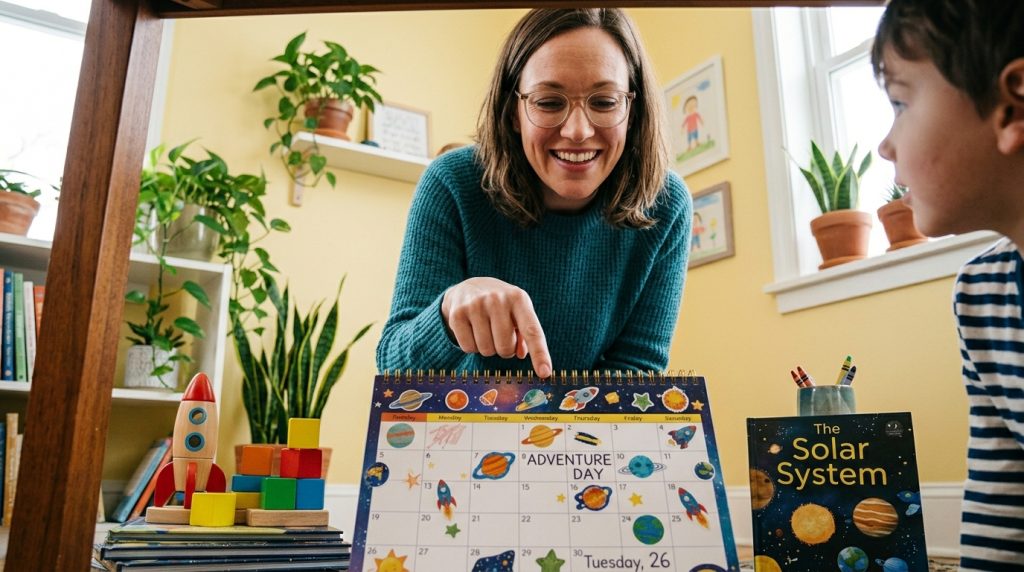
Kinesthetic children will not feel at home if their schedule requires them to sit quietly reading a book for two hours straight.
The second step is to adjust the schedule to the child’s circadian rhythm or natural biological clock. Some children are very fresh and focused in the morning, while others are brighter in the afternoon.
The third step is to incorporate the child’s personal interests and non-academic skills into the plan. The ability to read the Koran, master English, or assemble robotics is as important as science lessons.
The fourth step is to consider your busy schedule as a working parent or taking care of the house. Don’t make a schedule that requires you to accompany your child 100% of the time if Mom has a virtual meeting at that time.
3 Examples of Daily Homeschooling Schedules that Can Be Applied
Here are three models of homeschooling schedules designed for your family’s varying levels of busyness and adaptation needs.
This schedule is just a basic framework that you must readjust to the real conditions at home.
Light Version of Homeschooling Schedule (Suitable for Transitions)
This version is highly recommended for families just starting their home-based education journey. The main focus is on building habits without putting excessive academic pressure on the child.
07:00 – 08:00: Wake up, make your bed, shower, and have a healthy breakfast with your family.
08:00 – 09:00: First academic session. Focus on core subjects such as Math or Science.
09:00 – 09:30: Take a relaxing break. Children can snack or play freely around the house.
09:30 – 10:30: Second academic session. Focus on literacy such as reading stories or writing a journal.
10:30 – 11:30: Physical activity or light exercise. You can cycle in the complex or do gymnastics together.
11:30 – 13:00: Long break, nutritious lunch, and afternoon worship.
13:00 – 14:00: Practical skills or light household tasks. For example, helping mother wash the dishes.
14:00 – 15:00: Quiet time. Children can read their favorite book, draw, or take a nap.
15:00 and above: Free to do activities with family, chat, and get ready for the night’s rest.
This learning routine is very relaxing and ensures that children do not feel confined by strict rules.

Normal Version Homeschooling Schedule (Balanced and Structured)
This version of the homeschooling schedule is the one most widely used by practitioners because of its excellent balance between theory and practice.
Suitable for children who are used to the rhythm of independent learning but still need daily guidance.
07:00 – 08:00: Morning preparation, breakfast, and prayer before starting daily activities.
08:00 – 09:30: Morning academic block (Mathematics and Natural Sciences).
09:30 – 10:00: Break and snack time to restore brain energy.
10:00 – 11:30: Second academic block (Indonesian, History, or Social Sciences).
11:30 – 13:00: Lunch with family and worship.
13:00 – 14:30: Non-academic skills development. For example: Koran lessons, learning English, or practicing a musical instrument.
14:30 – 15:30: Fun creative projects or independent experiments without parental intervention.
15:30 – 16:30: Afternoon exercise, playing in the park, or socializing with peers in the neighborhood.
16:30 and above: Shower, dinner, family time, and prepare for bed.
This schedule includes the right portion for talent development through extracurricular activities at home.
Intensive Version Homeschooling Schedule (Specific Target Focus)
The intensive version of the homeschooling schedule is used situationally, for example when the child is preparing for an equivalency package exam.
Can also be applied to high school students who are pursuing a portfolio to apply to their dream university.
06:30 – 07:30: Wake up early, light exercise to pump blood to the brain, then have a nutritious breakfast.
07:30 – 09:30: In-depth academic session 1. Discussing exam questions or material that requires high concentration.
09:30 – 10:00: Get quality rest. Avoid looking at your device screen during this break.
10:00 – 12:00: In-depth academic session 2. Continue research, reading heavy literature, or science practicum.
12:00 – 13:30: Complete rest time, filling lunch, and worship.
13:30 – 15:00: Special mentoring session. This is the ideal time for a private tutor to step in and help with a child’s difficulties.
15:00 – 16:30: Professional skills training. For example advanced coding classes, graphic design, or writing English essays.
16:30 – 17:30: Mental relaxation activities. You can listen to music, take an evening walk, or garden.
17:30 onwards: A complete break from heavy academic activities, a leisurely dinner, and a short daily review with parents.
This schedule requires high discipline, so nutritional and moral support from parents is the key to success.

Real Example: Family Case Study in Sidoarjo
To provide a more concrete picture, let’s look at a simulation of Mr Budi’s family’s learning routine.
Mr Budi’s family lives in Sidoarjo and has a daughter named Rara who is in the 5th grade of elementary school. Mr Budi and his wife both have side jobs from home as entrepreneurs.
They choose a normal version of the homeschooling schedule with slight modifications to fit their work rhythm. Every morning from 08:00 to 10:00, Mrs. Budi accompanies Rara to study Mathematics and Science.
After lunch break, at 13:00, it was Rara’s turn to study independently using interactive modules on her laptop. This gives Mr and Mrs Budi time to take care of shipping their merchandise.
In the afternoon, at 15:00, a private tutor came to the house to teach Rara English interactively. The evenings are used purely for relaxing, watching documentaries together, or reading stories before bed.
This family proves that independent education is possible even though parents are busy working. The key is communication, clear division of tasks, and delegation of difficult material to experts or private tutors.
PakarPBN
A Private Blog Network (PBN) is a collection of websites that are controlled by a single individual or organization and used primarily to build backlinks to a “money site” in order to influence its ranking in search engines such as Google. The core idea behind a PBN is based on the importance of backlinks in Google’s ranking algorithm. Since Google views backlinks as signals of authority and trust, some website owners attempt to artificially create these signals through a controlled network of sites.
In a typical PBN setup, the owner acquires expired or aged domains that already have existing authority, backlinks, and history. These domains are rebuilt with new content and hosted separately, often using different IP addresses, hosting providers, themes, and ownership details to make them appear unrelated. Within the content published on these sites, links are strategically placed that point to the main website the owner wants to rank higher. By doing this, the owner attempts to pass link equity (also known as “link juice”) from the PBN sites to the target website.
The purpose of a PBN is to give the impression that the target website is naturally earning links from multiple independent sources. If done effectively, this can temporarily improve keyword rankings, increase organic visibility, and drive more traffic from search results.